2026-02-11
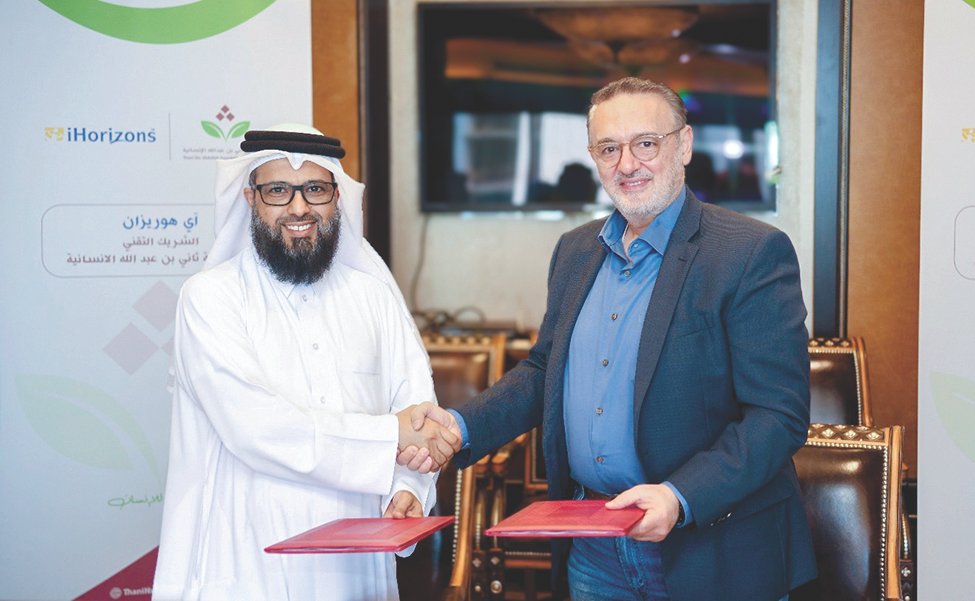
Thani Bin Abdullah Humanitarian Services Foundation signed a technical partnership agreement yesterday morning with iHorizons, aimed at building information systems and digital applications that will enable the Foundation to deliver its humanitarian services to eligible beneficiaries entirely through advanced technologies.The agreement was signed on behalf of Thani Bin Abdullah Humanitarian Services Foundation by Dr. Ayed bin Dabsan Al-Qahtani, CEO of the Foundation, while Mr. Mohammed Al-Tikriti, CEO of iHorizons, signed on behalf of the company.Speaking at a press conference following the signing, Dr. Ayed stated that the agreement comes within the framework of the Foundation’s social responsibility, with iHorizons becoming a technical partner of Sheikh Thani Bin Abdullah Humanitarian Services Foundation, in line with the return of humanitarian institutions to actively play their role in serving the community.He explained that the agreement aims to develop the Foundation’s infrastructure, enabling it to implement projects using modern technology and facilitate communication channels.Dr. Ayed noted that this cooperation aligns with the State of Qatar’s direction toward leveraging technology across various transactions and enhancing electronic connectivity. He expressed his gratitude to iHorizons, its owners, and its management for this positive initiative, which reflects their commitment to serving the community.He added: “At Sheikh Thani Humanitarian Services Foundation, we take pride in this initiative and hold it in the highest regard, as it represents a living example of the role of national companies that contribute to the prosperity of society and sincerely seek to serve it and serve beneficiaries within the State of Qatar.”Dr. Ayed pointed out that the agreement signed is an executive framework agreement to launch the Foundation’s dedicated application, in addition to multiple technical tracks.He stated that the Foundation’s interaction with the public will be conducted through remote digital channels, similar to practices adopted by several institutions and programs within the country. He also noted that the Foundation will provide a qualitative addition by moving from training employees, staff, and volunteers to a new phase that also includes developing, qualifying, and training beneficiaries themselves, enabling them to effectively use and interact with these technologies.He explained that this will be achieved through organizing campaigns in shopping malls or in specific areas where the public is present, to provide direct training and education on how to use these technologies, simplify access to the application and website, including uploading documents and supporting papers, and verifying eligibility.He emphasized that the goal of the agreement is to simplify procedures for both beneficiaries and donors alike, facilitating access to services and enhancing efficiency. He clarified that what is currently taking place is not a standalone activity, but rather an infrastructure-building process, with actual operational activities expected to begin within the next two months, God willing.He stressed that training is a fundamental component of all technical projects, as the process is not limited to technical development alone, but also includes change management within institutions, to ensure real benefit from development efforts and to avoid wasting time or resources.He further explained that management is focused on empowering Foundation staff to use these modern technologies, and that training — or knowledge transfer — is a core element of this empowerment, whether through training courses, workshops, or early-stage involvement, to ensure that all staff engaged in this type of work reach a level that enables them to effectively deal with modern technologies, especially those related to artificial intelligence.He noted that this partnership also focuses on developing existing content, updating current systems, as well as creating new systems and advanced technical tools that serve users and meet their needs.He added that artificial intelligence will be a central component across all tracks, whether in project-related programs, those directed at assistance applicants, or programs dedicated to donors and benefactors.For his part, Mr. Mohammed Al-Tikriti expressed his thanks and appreciation to the management of Thani Bin Abdullah Humanitarian Services Foundation for their valued trust in his company, affirming that this trust represents an honor and a badge of pride.He added that iHorizons, as a well-established Qatari company with more than 30 years of experience working with most major institutions and authorities in the country, views working with a charitable foundation as having a special character, given the noble humanitarian message it carries and its direct service to society.Mr. Al-Tikriti confirmed that Dr. Ayed’s vision as CEO of the Foundation and his leadership reflect a firm conviction in the importance of technology as a fundamental driver of charitable work, as it is the channel through which the message is delivered, services are provided, and communication with all stakeholders — whether beneficiaries or donors — is strengthened.He explained that through this partnership, iHorizons is keen to provide the latest advanced technologies, including sophisticated digital solutions, with a strong focus on user experience in terms of simplicity, clarity, and speed of service delivery.